
If you’ve been playing poker for half an hour and you
still don’t know who the patsy is, you’re the patsy.
Warren Buffet
I’ll get straight to the point: Canadians exemplify drive and ambition when chasing a puck. Americans exemplify drive and ambition when chasing a buck. Hockey was a sport. Now it’s a business. That’s why Canadians are losing the puck.
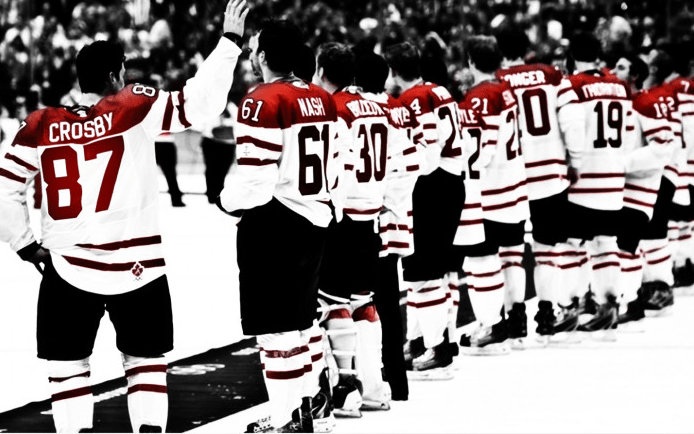
Buffett’s insightful statement about poker should be ringing in the ears of Canadians like a slapshot off the post. A year ago, our former Prime-Minister smugly tweeted ‘you can’t take our game’ after Canada won by the thinnest of margins, in a game that could have gone either way, against an American team that was solid all around – on the offensive, on defense, and in net. Canadians are used to seeing their teams sporting the maple leaf win often at international hockey tournaments. As we witness the Canadian women’s team implode against the Americans in the last year or so, and observe the junior teams struggle at international tournaments, the truth of what’s going on is unavoidable. To be blunt, and sorry Justin, but they already took our game.
When I was a kid I perused my extensive hockey card collection. The vast majority of players came from villages I’d never heard of in Manitoba, Saskatchewan, Quebec, Ontario, and across the country. A few stars came from Europe, a handful from the U.S. The all-star game was almost exclusively one team of Canadians against another. The 1978 roster included 37 Canadians, 2 Swedes, 1 American. Today’s NHL is a global mosaic. The team that won the Cup last year was about a third Canadian, a third American, and a third European. Or examine the rosters of the 2024 all-star game: 14 Canadian, 14 American, and 16 players from 6 European nations.
That the game goes beyond some colloquial gathering invented on the frozen ponds of a northern nation and becomes an internationally enjoyed sport is amazing and deserved. The natural consequence of this is that other countries play it and they are playing it very well. Canada woke-up to this reality in 1972 with the Soviets. It was a ‘friendly’ tournament, but hockey being a matter of immense national pride in Canada, and given the Cold War that was at its peak, that narrow victory is glorified here in a way that would suggest that we had won both World Wars.
The Russians have been the team to beat for most of the last fifty years. Now, the team to beat is the U.S.A. That is – if Canada can overcome its penchant of having their group of superstars play an uncoordinated and undisciplined hockey and lose before even getting to the big game.
The new rivalry is certainly entertaining. The small country always dislikes losing to the giant next door. The David’s of the world relish seeing Goliath fall – even if it happens once in a blue moon. Denmark hates losing in soccer to the German powerhouse it lives next door to. The same can be said of Scotland and England, Portugal and Spain. However, in a context where the current president is outwardly belligerent towards Canada and American players instigate unprovoked fights against their colleagues and teammates just because the players were divided by the North-South border rather than the East-West division, the stakes are higher. Previously,
we could lose and shrug it off. Given how much hockey talent we export across the border, we knew that on average, and in the long run, we’ll have the upper hand – at least in hockey. In this context, a loss feels more like watching your once friendly neighbour defiantly park their Winnebago on your front lawn. Even today, a loss is not catastrophic – a good rivalry requires an even match – what matters more is not having to hear about it on a certain self-serving social network.
It is an odd turn of events to feel threatened by the U.S. Canada is the most American of all the nations on earth. We love vacationing there, we get along well with the people, and share so much in common with our neighbours. We celebrate the fact that we fight shoulder-to-shoulder when it matters. We welcome open trade even if, at a 10-1 population and economic disadvantage, our country is flooded with foreign goods. The fact is that American goods, culture, and values, don’t feel foreign to us. We even cheered for the U.S. when they played the Soviets – after all, we certainly feel more American than Russian.
So, how did Canada – a nation that bred the most and best players only a few decades ago – get into a position where we are no longer the favourites? It may not feel like we should be panicking right now. After all, Canadian teams are packed with talent. Our national teams snub some of the best players in the game simply because their isn’t enough room for everyone on the team. Many of these players would be the all-star of many nations we confront on the international stage. However, winning is far from guaranteed. Future Olympics and tournaments are being decided among our pee-wees at this moment.
The answer is quite simple: Hockey stepped into the fold of the American sport-industrial complex. The first American commissioner of the league moved HQ from Montreal to NY in 1989. This was about TV contracts and expansion. That was just after a teary-eyed Gretzky moved to LA because it was “good for the game.” At the time, I didn’t understand; how is playing where palm tress grow going to make this sport – a unique blend of speed and finesse with grit and toughness – better. Of course, he meant the business of hockey. If we lose a game today, it’s in part because we lost the game itself many years ago. (This is not laying blame on the Great one, he was simply a player in a overall push to make a great game greater.)
The gravitational pull towards the big market, already well in force in many other spheres, shifted to hockey and it is gutting our local systems. It’s the “money game” now. It’s no longer just the pros heading south for the lucrative salaries; we’re seeing a mass exodus of Canadian Juniors opting for the U.S. college system over our own. How many less of these rising stars will inspire young kids in hockey towns across Canada to strive for greatness on the ice if they are not on display in local arenas? How many of those talented boys and girls will marry, work, and live in the U.S.? How many will end-up coaching their kids and the neighbours kids instead of our youth?
I’m not saying that the international appeal of hockey isn’t good for the game. I’m not being nostalgic. These days I enjoy more jazz much more than I watch hockey. Jazz was born in the soil of New Orleans. Today, the stars and innovators of jazz on my playlist come from every corner of the planet. I listen to more Scandinavian, Israeli, Italian, and Canadian musicians than American. We are witnessing the same type of shift in hockey. Maybe what is great is that fans appreciate the game more than the passport of the players. People in Pittsburgh love Sid and Torontonians love Auston. Moreover, as our dominance in hockey falls, the face of the country is changing and our interests too, our competitiveness in soccer and basketball is rising. It is not so much that Canada is getting worse at hockey, but that the world is getting better. That’s a good thing.
But, can Canada get better as others do? This is where my concerns are. Hockey participation among youth has been declining in Canada for years. The opposite is occurring in the U.S. The
moves made in the late 80’s and the subsequent expansion of the league is bearing fruit. With the exodus of youth to the U.S. college system we are feeding their machine with our talent. Are we stepping-up with an alternative that makes sense for these youngsters? Are we doing enough to make hockey affordable and attractive to young families? Are we growing our economy and thus our ability to support professional teams and youth sport? You might bet on teams sporting the maple leaf today, but would you make the wager on a team a decade hence? Extend the question to any sport you care about.
The answer is obvious: The bet depends on the investment.
Addendum: Congratulations to all the players, from every country, win or lose, your efforts were fantastic to watch.
The American women’s team played best throughout the tournament and deserved their gold medals. The Canadians should be proud of the grit they displayed. The result, often attributed to the youth of the American team supports my thesis about Canada losing it’s edge.
Men’s game: The inevitability that these teams would meet supports my thesis as well: The effect of scale – U.S. population and economic might – makes it inevitable that once they get interested in something, they will get good at it too. In the end, we know the players wearing red reluctantly accepted a silver medal. They were only interested in gold. And there is little if anything to criticize about their play and nothing to hang their heads about. In a single hockey game a hot goaltender can make or break a team (or series) as can a bad bounce or a bad call. Canada had all that and more to overcome. Still, take a step back and one has to wonder how the best team on paper, and the best on the ice, still had so much trouble scoring after massively outshooting all their playoff opponents. Take a step further back and their are two perspectives one can take: 1) This may be my jazz theory playing out. Talent is simply distributed globally in a much more uniform manner. 2) Sport history is about victories. History is written by the victors. These wins are the stuff that inspires youth. And that’s going to happen on the other side of the border, where the momentum is already stronger. It is imperative that we ask if Canada needs to look at player development, participation in sport, and economic strength and ask to what extent it is complacent and complicit in the loss of the game overall.
Further studies in Canada’s mishandling of the puck:
1) Malcolm Gladwell’s improvisation on Hockey Canada’s oversight and what it means for youth development: https://www.pushkin.fm/podcasts/revisionist-history/outliers-revisited
2) Quebec government study into the decline of hockey (French): Le hockey, notre passion — Rapport du Comité québécois sur le développement du hockey. The breakdown of the 9 pillars identified by the committee.
K. Wilkins is the author of:
Stoic Virtues Journal: Your Guide to Becoming the Person You Aspire to Be
Rules for Living Journal: Life Advice Based On the Words and Wisdom of Jordan B. Peterson
 Find Your Journal