
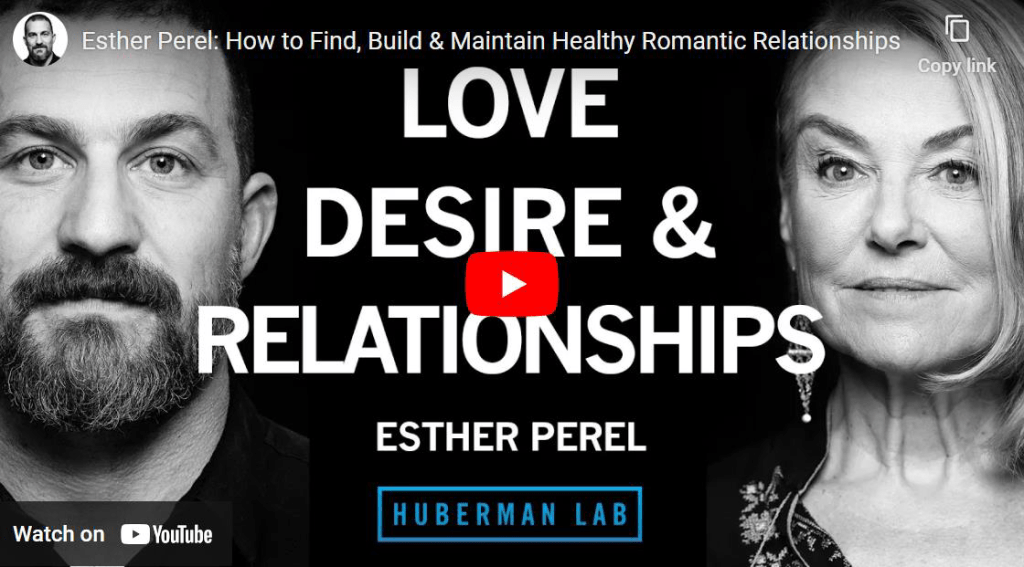
Esther Perel on what you’re really struggling with from this valuable conversation:
We grow up and we have both needs, togetherness and separateness. And then we come out of our childhoods and some of us need more space, freedom, separateness, and some of us need more protection, connection, togetherness. Of course, we tend to meet somebody whose proclivities match our vulnerabilities.
And so you find that in many relationships, you have one person who is more afraid of losing the other and one person who is more afraid of losing themselves. One person more afraid with the fear of abandonment and one person more afraid with the fear of suffocation.
Which is it for you? Perel gives us a trick to figure it out: Just reflect upon conflicts.
So then the next question is, how often do you not say what you really think? Because you want to please, or you want to harmonize, or you want to avoid conflict. How often did you then resent the partner who actually stood for their ground? Because if you’re afraid to lose yourself, you’re often more the one who stands for your ground. You don’t give in. And if it’s rigid, you don’t give in at all because you think that every time, even the language, agreeing is giving in and giving in is losing a part of myself.
This opens up a whole world of possibilities for the next conflict. What you’re fighting is probably not what you’re actually fighting about. The argument over the cap on the tube of toothpaste has little to do with toothpaste. We all know that common subjects of disaccord such as domestic chores, children, intimacy, and money are really about values. This framework goes a level deeper, into how we walk a fine line between valuing our autonomy and our mutual dependence. It’s especially important because losses impact us more than gains. We will generally forego the opportunity to gain $100 if the chance of losing $50 is involved. We will want the pleasure of accolades and public success, but would rather die than speak in public and suffer the potential pain of embarassment or reputational damage.
With insight into what they don’t want to lose, and what you might be holding on too tightly to, how you do this dance can change dramatically. The next time an argument surfaces, consider that you or your partner might not want what you say you want, rather, it might be about what you don’t want to lose.
K. Wilkins is the author of:
Stoic Virtues Journal: Your Guide to Becoming the Person You Aspire to Be
Rules for Living Journal: Life Advice Based On the Words and Wisdom of Jordan B. Peterson
 Find Your Journal