
FOMO, FOPO, and Following Your Own Advice
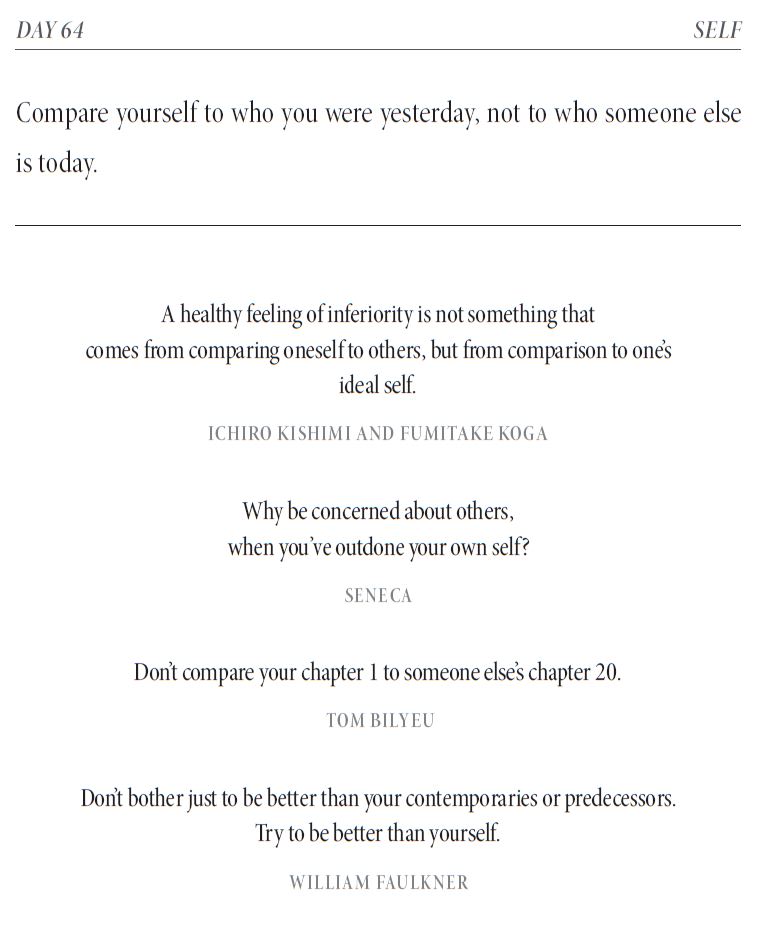
Can you really stop comparing, and just stay on your path? Is it really your path? And how many paths are too many paths anyways? Those are the unspoken questions in this series of quotes from the Rules for Living Journal.
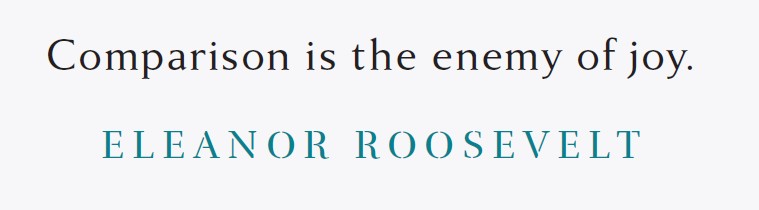
Eleanor Roosevelt has some wise words about this too, “Comparison is the enemy of joy.” (included in theStoic Virtues Journal)
Of course, even if we try to focus on being better today that we were yesterday, we must admit that limiting ourselves to that yardstick is wholly unnatural. Once you see where others are, you can’t unsee it. Yet, for the sake of happiness, we should try to drag our attention to the race we run with ourselves – as hard as that is.
We only need to take the epidemiological approach to infer how pervasive the dis-ease that comes from comparing ourselves to others is. Apparently, the happiest people in the world live in Bhutan. Two notable things that are different there: they mediate on their eventual death daily (this will be the subject of another post), and, there is virtually no social stratum (everyone’s poor – compared to us), and they are less oriented towards possessions (and thus, maybe don’t feel so poor). Which is the key ingredient to their happiness we don’t know. A quick look at happiness levels in other parts of the world suggests that comparison is definitely part of it. In the land of opportunity, the United States (ranks 16th), people rate themselves lower in happiness than in more socialist places, such as Canada (ranks 14th), a country where the government intervenes more aggressively – lest one fall too far behind or get to far ahead. And the residents of countries with governments that play Robin Hood to an even greater extent, the Scandinavian countries (Finland, Denmark, Iceland) for example, all sit bear the top of the happiness chart. [i]
This is not an argument in favor of socialism or poverty, it simply illustrates how pervasive the proclivity to compare is and how destructive it is to our sense of wellbeing. That comparison to others might have something to do with the relative happiness across nations is hinted at by a seminal economics study.[ii] When asked to select a preference between earning $50,000 per year while others earn $25,000, or earning $100,000 while others earn $200,000, half of the respondents would prefer to earn less, as long as it is more than others. In other words, success is relative, having more than others can matter more to us than having enough or a lot. Or, better to suffer a little, as long as we suffer less than others. It would seem that comparison is at once the enemy of joy, and a shortcut to avoiding pain – it all depends on our frame of reference, the direction in which we look.
We continue to look outward to compare ourselves, even if we all know implicitly what Eleanor Roosevelt made explicit. We know that every time we look, no matter how much success we accrue, somebody always has more; no matter how high we climb, somebody is higher. Enough is a goal post that eludes us because it inches further away, it is just around the corner, where someone else already is.
So, let’s say that you do break free of looking upwards at the success of others and therefore stop looking down on yourself? If you do develop the habit of comparing yourself to your former self instead, will that do the trick? Will that make you happier?
I’m not so sure. A recent conversation with a friend suggests that this is an important upgrade to our internal operating system, but maybe only a first step. My friend was agonizing over a decision to drop-out of an upcoming ironman competition as doubling an already demanding training schedule in order to be in top shape for the event would be overwhelming for someone with a schedule that is already fully subscribed. Looking at the situation from the outside, it’s a no-brainer: there is no need to burn-out, there is no shame in choosing to focus on other things instead. On the personal and professional front, she is by all measures already very successful. Her current exercise regime probably puts her in the 97th percentile in terms of personal fitness. A line from J.K. Rowling’s commencement speech at Harvard came to mind – “Your conception of failure may not be too far removed from the average person’s idea of success, so high you have already flown.” Yet, to her, she is still letting herself down. This is natural, she is comparing. Except, in the other direction, she is comparing herself to the future-self she has imagined for months now – the one who crosses the finish line – with the one who watches from the sidelines.
This is the tricky part of being your own benchmark. You are definitely the right person to compare yourself to, make no mistake, only you come with all the advantages and disadvantages that make you unique. However, even when we turn our attention to ourselves instead of others, that does not mean that we always like what we see, or allow ourselves to be satisfied. In my case, even if one were to shower me with praise for some accomplishment, say my education, or my fitness level, or whatever, I am woefully unimpressed. I am keenly aware of all my insufficiencies. When Present-Me compares himself to Past-Me, there is some mild satisfaction with the progress made or the trajectory things are on. But, this brings past me into the picture, this gives him a voice too. And Past-Me knows what he expected of the Future-Me (that is now Present-Me). For I know exactly what I could have and should have done and thus where I would be had I done so. No matter how high I climb or how hard I try, I know where I ought to be and what I ought to do. I am never enough in my mind because I compare me as I am to me as I could be, and to me as I want to be. In sum, there’s a lot of comparing going on and less joy than there could be (and maybe should be).
Of course, how much joy we rob ourselves of can depend on what exactly pushes us. The drive to be more and do more can come from dark corners of our psyche. Having something to prove to yourself or to others can fill us with this dark energy. Read a bunch of biographies of many accomplished people and you’ll find that many were anything but well-adjusted and balanced. Michael Jordan is a great example: One of the greatest competitors of all time, his whole career may have been fueled by a desire to prove everybody who doubted him wrong. Without that chip on his shoulder he may never have developed the passion for practice (he once said he’d rather miss a game than practice) that made him who he was. Jazz pianist Oscar Peterson asked his father’s permission to drop-out of high school to dedicate himself to music. His father said yes, under one condition, be the best. Oscar spent his lifetime striving for that; but most of all he was striving to fill a void and earn his father’s acceptance.
These are extreme examples, perhaps cautionary tales that force us to examine why we set the bar so high. It behooves all driven people to examine if their climb is out of a void, if they are filling their schedule or their trophy shelf to find self-worth. This is a form of striving that has limited impact. As John Candy’s character in Cool Runnings says, “A gold medal is a wonderful thing, but if you’re not enough without it, you’ll never be enough with it.”
Drive often comes from a place of lightness too. Our motivation can be the fruit of a sense of optimism about what we could do and a passion for life and experience. Saying no to a potential or to an opportunity is to place constraints on that higher self that is burning to come into existence. For my friend (I believe) the dissonance associated with foregoing the race is more than likely coming from the pain of limiting her vision of her future self rather than expanding it. This deep desire to say yes to all life has to offer and be all we can that is a healthier form of comparison. It does not immunize us from some disappointment, when we dare set the bar high in terms of the life we want and expect, we never quite live-up to it. I believe and I hope my self-comparison comes from this place too (the look outwards to others as includes many positive examples too). How many among us fall behind because they have no positive models or ideals to hold themselves too?
It would seem that not comparing is out of the question if one has aspirations. If we dare imagine a better self we are by definition comparing our current state to a desired future state. We owe comparison a debt of gratitude, for it has certainly helped us get to wherever we are, regardless of how satisfied we are with that current state. If we are hopeful about the future, it is because we can see something better on the horizon, compared to what is now, of course. Thus, the gap between what we want and what we have, or who we are, is as much a solution as it is a problem. Comparison is a feature as much as it is a bug.
Ultimately, we need to ask ourselves: Are we driven by FOPO (fear of other people’s opinions) or FOMO (fear of missing out – on the joys of living and realizing our full potential)? This is, I believe, is the first step in ensuring that we can integrate our instinct to compare in a healthier way.
This may not lead to inner peace, for, even when striving from a good place, we are still striving – there is an internal civil war, between being and becoming. Ideally, we would be at peace with what has been and what is, all the while being drawn to becoming something more. It would seem that the trick is to be hungry (unsatisfied) enough to move forward and bring forth a better version of ourselves, yet still be (mostly) satisfied (enough to feel pride for what we have become, hope that we can be an agent of change, and compassionate enough with ourselves to give ourselves a margin or error to attempt to improve). The problem of not being all we could be is an intractable problem, it will never go away. Thus, the second step to in integrating our instinct to compare in a healthier way is our relationship between reality and expectations. The (purported) words of Captain Jack Sparrow sum this challenge up best: “The problem is not the problem. The problem is your attitude about the problem.”
The perplexing part about this second step to comparing without being a tyrant is that most prove that they are perfectly capable of doing this – for others that is. Any parent actively works every day to hold their child to a high standard without demoralizing them. Sure, from time to time you’ll give them the swift kick in the ass they need, but, for the most part, the parent acts like a coach. You will communicate that they can and should do better, that any arbitrary limitations they impose upon themselves are ridiculous, and will provide encouragement and support. We love the child for who they are right now, and who they can be. Blockages at this level – if we can only give ourselves swift kicks on our own behinds without any pats on the back – might signal an incapacity for self-love and self-acceptance.
Even if we learn to be encouraging coaches for ourselves, we may not be out of the woods yet. Even if we have a good relationship with ourselves (yes, you have one, and as we saw above, it might not be amical), we may still have issues with our relationship to limits per se. My friend’s grand ambition to do more exercise in a day than most people do in a year is a prime example. The question is not whether this is doable, it certainly is. The whole point of doing it is to stretch a limit. That is what makes it a desirable objective. Limits exist to be exceeded. However, constraints are also liberating, too much choice, too much possibility creates anxiety – we find the way out or forward by eliminating what won’t work. Numerous studies show that creativity and innovation increases when people embrace constraints[iii]. Too many constraints stifles us, but too few give us too many options and paralyzes us. The challenge is thus, to push our limits yet accept limitations. Something I still can’t do after five decades of practice. Each day, I accomplish so little compared to what I had expected to achieve. The bar is consistently far above anything I’ve ever proven capable of doing. The question is one of expectations: Why do we put more on the plate of our future-self than our present or past selves can handle? The optimism surrounding what we could and should do needs to come with a healthy dose of realism about what we can expect from ourselves.
Does this mean that we should lower our expectations? Perhaps the people in Bhutan have enough because they are less exposed to overabundance. I’ve heard a Dane proclaim that low expectations are a core ingredient in their recipe for a happy life. However, as we have seen, lowering the bar is to cheat us of our potential. High expectations are motivational, we need goals beyond our reach. That being said, expectations are at the core of the third and final element to developing a well-adjusted comparative framework: It is not on how high or low we set our expectations but where we place them.
Think of this: You’re driving home from a soccer tournament and your young child is in the backseat brooding over a loss. There’s a good chance that you’ll pull out the old maxim, ’it’s not if you won or lost, but how you played the game.’ And you know that this is not a platitude, you are not just saying something to distract them from their pain. You’re proud of them as long as they played fair and played hard. You say that and you mean it – effort, not results are what really matters. But do you follow your own advice? When we are in a funk over missing the mark in relation to our own expectations this might be exactly the wisdom we need. Is your focus on where you’re at rather than how you played the game? So you haven’t become an overnight success: Have you put in the ten years of hard work required for that to have a chance of happening? (A chance that is, no guarantees). Why do we compare our achievements for the day or our accomplishments to-date on results rather than efforts (just as we would do with our children)?
For most driven people, regrets don’t materialize over the issue of effort, it’s not a situation where they spend too much time playing and not enough working – it’s often all effort, all the time. The statement, ‘how you played the game,’ is more complex for an adult. The child has few responsibilities: Play is the work of children Jean Piaget taught us. An adult also ‘plays’ many games simultaneously – he or she ‘plays’ many roles. And in some arenas, our survival and our future is at stake, it’s playing for keeps. But quantity (more) at the expense of quality (better) may be too high a price. The number of pro athletes that excelled at two sports you can count on one hand. Future-You will look back upon Present-You and judge him or her for the quantity and the quality of your efforts. That second part means that most of all, he or she will judge you for where you direct your efforts. Regrets, I’ve learned, are more likely to come from playing too many games, or not playing the right ones.
If we can’t avoid comparisons, and if we restrict our comparison to ourselves, we need to compare what we do today to who we wish to be tomorrow. Once again, we can look to how we treat others to guide our interactions with our self. We may not be comparing outside of our self, but there are still (in a sense) two people involved. We sometimes forget the fact because we think of both people as ‘I’ and thus forget that Future-You is fictional. We cannot be everything to everybody, even for those under our care. We set boundaries – not limits, we could do more, but we choose not to. Those boundaries are good for us and good for them. Without them, Present-You sacrifices too much of who they are and who they could be. This is perhaps the greatest challenge in the realm of effort, we care a lot about our Future-Self, but can only do so much for them without losing our grip on who we are now. A line must be drawn if there is to be peace.
Peace, however, often comes after a struggle. Blood must be spilt. All words ending in ‘cide’ invoke killing: pesticide, insecticide, fratricide. Deciding who we will not become is akin to homicide, you are killing a future you that could emerge. But something must die if something else is to live – this is a law of nature. To choose who we will be when we desire to be many things is as much an act of violence as it is an act of love, it requires much courage. Great writers like Faulkner and King remind us that if the story is to ring true, we must ‘kill our sacred darlings.’ There must be some decisive battles in your inner civil war. There must be a sacrifice – in some cases a future-self-sacrifice.
Robert Frost’s poem ‘Mending Wall,’ with the recurring couplets, ‘Something there is that doesn’t love a wall’ and ‘Good fences make good neighbors,’ comes to mind. The conflicting approaches of the characters in this piece – one asking why erect any barriers, the other rigidly and unquestioningly maintaining them – resonates with our inner struggle. The lines we draw, then maintain, and respect, are necessary for us to coexist harmoniously. Likewise, a good relationship with ourselves might have everything to do with negotiating those inner fences – getting clear on which walls we preserve and mend and which we tear down. Only with some fences can we live with this ‘neighbour-down-the-street’ that is our future self, even if we can’t help but compare ourselves to them and be envious of what they could have and we may never have.
K. Wilkins is the author of:
Stoic Virtues Journal: Your Guide to Becoming the Person You Aspire to Be
Rules for Living Journal: Life Advice Based On the Words and Wisdom of Jordan B. Peterson
[i] Happiness is a tricky thing to rank. Finland is top ranked by the ONU. However, Bhutan is not even included. Also, the measurement scale used by the ONU presumes wellbeing by including economic status.
[ii] https://www.sciencedirect.com/science/article/pii/S0167268198000894
[iii] https://hbr.org/2019/11/why-constraints-are-good-for-innovation
 Find Your Journal