
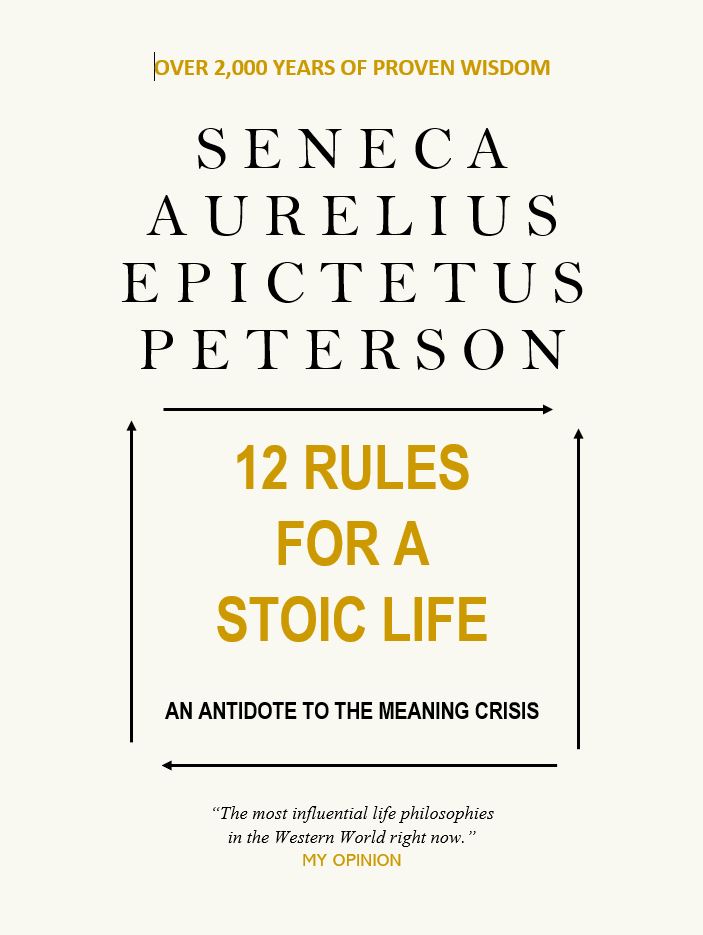
12 Rules for a Stoic Life
Responsibility and response: two words that underpin the writings of the Stoics and Jordan
Peterson. Two words with a common root, the Latin responsum “an answer.” Each of Peterson’s twelve rules come back to two things:
a) Life will be hard, how will you respond? The answer is with courage, to take the heroic
path, to voluntarily face difficulties and work to generate order from the chaos.
b) Meaning is the antidote to the inherent suffering in life. How will you find it? The
answer is in responsibility, in accepting the challenge of bettering yourself, your family,
your community.
Likewise, the Stoic texts that still enchant us two thousand years later also assert that life (fate,
or fortune in their parlance) will test you. Chances are that you will not saunter through it. As
Marcus Aurelius says: “The art of living is more like wrestling than dancing.” There will be things
that you can influence, and things beyond your reach. The ideal response to the struggles you
will inevitably face is to accept your reality and work to improve the things you can. Your
attitude and your actions to improve your fate are your answer.
To the Stoic, the noblest pursuit is the development of your character; the cardinal virtues
guide you on that path. While Christianity adapted those virtues, the underlying rationale
behind the virtues is somewhat different. The ‘do unto others’ ethic behind the virtues certainly
sowed social harmony and appeases one’s conscience, but is also promised entry into the
afterlife. The noble Stoic soul on the other hand, only earns dividends in the here-and-now.
Therein lies a clue to the Stoic notion of meaning. Without St. Peter to weigh the value of your
soul, it’s your own estimate of its worth and that of others that matters. Of course, the Stoics
advised heavily against anchoring your opinion to that of others, however, they also stress our
interdependency. The Stoic emphasis on the community aspect of justices, stressing doing
“what your nature demands” (Marcus Aurelius) and that “we are made for one another,”
(Seneca) underscores that your highest purpose is to be found in responsibility. Meaning is to
be found in taking responsibility for your own development and being of service to others.
Just as the cardinal virtues apply as well today as they did two thousand years ago, so do
Peterson’s rules for life.
RULE 1 (JBP): Stand Up Straight With Your Shoulders
Back
Life will be hard, you will need to compete with
others for attention. Status matters as much
today as it did in any previous age, even before
we were humans. We must cultivate courage and take on the responsibility of tackling the
inevitable difficulties and transforming the chaos of potential into the realities of habitable order. It means accepting our vulnerability and moving forward regardless. Attend to your posture, speak your mind and put your desires forward. Dare to be dangerous Peterson encourages us. It’s good for your health, for your life, and for us as a collective.
Rule 1 (Stoics): See opportunity where others see obstacles and you will become unshakeable
The mind adapts and converts to its own
purposes the obstacle to our acting. The
impediment to action advances action. What
stands in the way becomes the way.
Marcus Aurelius
No prizefighter can go with high spirits into the
strife if he has never been beaten black and blue;
the only contestant who can confidently enter the
lists is the man who has seen his own blood, who
has felt his teeth rattle beneath his opponent’s
fist, who has been tripped and felt the full force of
his adversary’s charge, who has been downed in
bloody but not it spirit, one who as often as he
falls, rises again with greater defiance than ever.
Seneca
The way out is through. The challenges you face bring out the best in you; they make you. Find meaning and cultivate personal growth by taking the challenges in front of you head-on. They either beat the life out of you or breathe it into you – it’s your choice.
RULE 2 (JBP): Treat Yourself Like Someone You Are Responsible for Helping
If you don’t always do what’s in your best
interest, including taking your medication, or
daring to imagine what your life could be like if
you actually pursued what you wanted, it might
be because you don’t think you deserve to be
happy and successful. You are often the architect
of your own misery and the foundation of that
edifice is your lack of self-respect. Learn to do
things that are good for you.
Rule 2 (Stoics): If you want good things and good friends in your life, start by being good to yourself
I have learned to be a friend to myself. Great
improvement this indeed. Such a one can never
be said to be alone for know that he who is a
friend to himself is a friend to all mankind.
Seneca
God laid down this law, saying: if you want some
good, get it from yourself.
Epictetus
It will be difficult to be respectful with others if
you don’t first respect yourself. The virtues are
cultivated first in the way we are with ourselves.
To be helpful to others we begin by helping
ourself. Do not wait to be pulled from your
misery or granted what you want by somebody
else. You won’t get what you deserve, rather,
you’ll deserve what you go and get.
RULE 3 (JBP): Make Friends with People Who Want the Best For You
Assume first that you are doing the easiest thing, and not the most difficult Peterson advises us. A delinquent person does not rise to the level of better-behaved peers, the group’s standards lower instead. Many like being surrounded by people that do not aspire upwards, its justifies their inaction. Have enough humility to surround yourself with people who are ideals in some way. It will not be easy to stand beside people that are better, but is better than being around people who would rather keep you down.
Rule 3 (Stoics): Good friends are not just ‘good’ because they know you well, they are good because they make you better
Associate with those who will make a better man
of you. Welcome those whom you yourself can
improve. The process is mutual; for men learn
while they teach.
Seneca
It is inevitable if you enter into relationships with
people on a regular basis that you will grow to be
like them…Remember that if you consort with
someone covered in dirt you can hardly avoid
getting a little grimy yourself.
Epictetus
Friendship should be about mutual support
rather than an occasion to commiserate, blame,
discourage, or make excuses. Good people want the best for you and to bring out the best in you – as you should for them. If you associate with people lacking in virtue it will rub-off on you.
RULE 4 (JBP):
Compare Yourself to Who You Were
Yesterday, Not Who Someone Else is Today
You will always find someone who is better than
you at something. Constantly doing so is
discouraging. Focus instead on your own
progress. Those tiny improvements compound
over time and propel you further than you could
have imagined. Also consider that your life is not unidimensional, you play many roles and you will be good at some and mediocre at others, it is the same for those you compare yourself too. It is more important for your wellbeing that you set your objectives and work to improve yourself than you win at everything.
Rule 4 (Stoics):
Being better than others is a losing
game, being your own best self is the only
contest worth winning
Why be concerned about others, come to that, when you’ve outdone your own self? Set yourself a limit which you couldn’t even exceed if you wanted to, and say good-bye at last to those deceptive prizes more precious to those who hope for them than to those who have won them. If
there were anything substantial in them they would sooner or later bring a sense of fullness; as it is they simply aggravate the thirst of those who swallow them.
Seneca
Stop aspiring to be anyone other than your own
best self: for that does fall within your control.
Marcus Aurelius
Focus on being the best you can be rather than
being obsessed with the status and possessions
of others. Those who get caught-up in this
treadmill are never satisfied for they always find
someone who has more to chase.
RULE 5 (JBP): Do Not Let Your Children Do Anything that Makes You Dislike Them
Your job as a parent is to discipline your child, to show them what is acceptable behaviour (and reward it) and discourage poor behaviour. This is different from being liked by your children at all costs. You are a proxy for the real world, and the real world is unforgiving of poor behaviour. If you guide them properly they will end-up appreciating you more for the social skills they develop and the self-discipline that will serve them throughout their lives. To do otherwise will lead to misbehaved children that you resent and ignore because you failed to fulfill your responsibilities to them.
Rule 5 (Stoics): Discipline will define your potential more than any God-given gifts
We should discipline ourselves in small things,
and from there progress to things of greater
value.
Epictetus
Be careful to leave your sons well instructed
rather than rich, for the hopes of the instructed
are better than the wealth of the ignorant.
Epictetus
Self-discipline is the road to self-mastery. Begin
with small things that strengthen your ability to
force yourself to check your temper when required, or delay gratification and thus reach our goals in life. Nurturing this trait of character
among our children will give them a better life
than leaving them with wealth.
RULE 6 (JBP): Set Your House in Perfect Order Before You Criticize the World
It would be easy and simple to blame all your
troubles on the economy, the government, your
parents, your boss, the national leader, or life
itself. Having someone to blame will make you
prone to ideologies that purport to “make the
world a better place” despite the fact that you
have not addressed the chaos within yourself
first. Learn first to improve yourself and put order in your life, your family, and use those skills at a community level or broader from there.
Rule 6 (Stoics): Fix yourself first
Be tolerant with others and strict with yourself.
Marcus Aurelius
Here is your great soul—the man who has given
himself over to Fate; on the other hand, that man
is a weakling and a degenerate who struggles
and maligns the order of the universe and would
rather reform the gods than reform himself.
Seneca
Being critical and intolerant of others is a
shortcut to making ourselves feel better about
ourselves. For too often it’s also an excuse that
justifies not bettering ourselves. Setting an
example is the best way to improve others.
RULE 7 (JBP): Pursue What is Meaningful (Not What is Expedient)
The successful among us delay gratification. The successful among us bargain with the future. They make the requisite sacrifices to obtain the resources, status, security, opportunity, and skills that make their life better in the future. What is expedient works only for the moment. It’s immediate, impulsive and limited. What is meaningful, by contrast, is not merely sacrifice in the sense of suffering now to suffer less later, it’s doing what is right, what is best, and what feeds your soul.
Rule 7 (Stoics): Measure your life in meaning, not in days
Give me by all means the shorter and nobler life, instead of one that is longer but of less account!
Epictetus
Pleasure, unless it has been kept within bounds,
tends to rush headlong into the abyss of sorrow.
Seneca
Pursuing pleasure has only short-term benefits if
not counterbalanced by the pursuit of things that also provide long-term benefits and give life a higher purpose. You have a role to play in the betterment of the world in some way. Your
principal task in life is to find where you can be of value to others and to do that to the best of your ability. Measure your life by its meaning.
RULE 8 (JBP): Tell the Truth, or at least Don’t Lie
If you lie to others about you, they won’t really
know you, and neither will you. Lies are the selflimiting beliefs you have about yourself; they are the ways you insist that the world be other than it really is; and the things you say that are done only to gain status, impress people, or get your way. None of those falsifications will ultimately get you a better life. They will only require additional lies to support the original lie as you try to avoid reality. That only works up to a point, then the walls will come crumbling down, or, to use Peterson’s metaphor, the deadwood will accumulate and the forest will burn spectacularly. Truth, even if hard, must be your North Star.
Through truth you will have engaging
conversations that help you sort yourself out, you will connect more deeply with others, and people will want to help you.
.
Rule 8 (Stoics): You can fool yourself, but you cannot lie to yourself
A guilty person sometimes has the luck to escape detection, but never to feel sure of it.
Seneca
Eyes will not see when the heart wishes them to
be blind. Desire conceals truth as darkness does the earth.
Seneca
Your conscience will always torment you for your wrongdoing. Guilt will have you always wary of being detected. You can construct castles of sand and temporarily convince yourself of things that are untrue, but you will always know that you are a fraud. What you rationalize, and whay you truly believe are entirely different things. Being truthful, seeing things as they are, rather than how you wish them to be, is a skill that must be cultivated.
RULE 9 (JBP): Assume that the Person You Are Listening to Might Know Something You Don’t
We often listen with the intent of replying (and
telling our own story, sharing our own opinions,
and impressing them in some way) rather than
actually hearing what the other person is saying.
We listen and evaluate what they say rather than
simply staying curious and extracting whatever
lessons they have to share with us. To do so
requires humility, but it’s worth it.
Rule 9 (Stoics): If the people you talk to never make you feel silly, then you’re not talking to the right people
Nature hath given men one tongue but two ears, that we may hear from others twice as much as we speak.
Epictetus
If anyone can prove and show me that I think and act in error, I will gladly change it-for it’s the truth I’m after, and the truth never harmed anyone. What harms us is to persist in self-deceit and ignorance.
Marcus Aurelius
You can’t learn anything from others if you do all the talking. You may learn that you are wrong or ignorant. This will hurt your ego, but not as much as not listening, not accepting any corrections to our ways, and never learning.
RULE 10 (JBP): Be Precise in Your Speech
Avoid sins of omission. Leaving things vague, such as your wants and your desires, and your
problems won’t make them go away. Problems
swept under the rug grow into insurmountable
obstacles. Admitting that the problem exists is
difficult, but better than the alternative. Risk
conflict in the present for longer term peace and
happiness.
Rule 10 (Stoics): If you don’t own your problems, they own you
Let us say what we feel, and feel what we say; let speech harmonize with life.
Seneca
Justice: so that you’ll speak the truth, frankly and
without evasions, and act as you should—and as other people deserve.
Marcus Aurelius
Most of us think in words, we must therefore be
careful with our words; they are the echoes of
our thoughts, and the seeds of thought as well.
How you frame things (opportunity, challenge,
problem) will impact the energy you bring to it
and ultimately, the solution. You must admit your errors if you are to improve. You must speak your truth if you are to have social relations that are fruitful in the long-run. It
is a duty to yourself and to others.
RULE 11 (JBP): Do Not Bother Children when they are Skateboarding
Life is a dangerous sport, one only wins at the
game by learning to deal with danger. We do not do anyone, children, or ourselves, any favours by making everything safe and easy. It is in our nature to explore and expand our limits, both personally and as a species. We cannot
overprotect ourselves and fulfill our potential at
the same time.
Rule 11 (Stoics): If nothing’s on the line, then nothing will likely come your way further down the line
It’s not because things are difficult that we do not
dare. It’s because we do not dare that they are
difficult.
Seneca
I judge you unfortunate because you have never
lived through misfortune. You have passed
through life without an opponent— no one can
ever know what you are capable of, not even you.
Seneca
You are capable of more than you think. You have more potential than you even allow yourself to believe. Only by testing your limits will you discover this. You will struggle in those difficult moments, but they will also make you more than you are now. Your greatest opponent is yourself. If you don’t challenge yourself to be more, then you will be less.
RULE 12 (JBP): Pet a Cat When You Encounter One on the Street
There will be trying times, life comes with crises, be grateful for the good things and alert to find them. Those we love are full of flaws, we must take the good with the bad and notice that we also love them for their limitations. In does us well at times to stop thinking and just notice that “the wonder of Being might make up for the ineradicable suffering that accompanies it.”
Rule 12 (Stoics): When you arise in the morning, rejoice, for you’ve hadn’t had your worst day yet
In the meantime, cling tooth and nail to the
following rule: not to give in to adversity, not to
trust prosperity, and always take full note of
fortune’s habit of behaving just as she pleases.
Seneca
If you are kissing your child or wife, say that it is a human being [a mortal] whom you are kissing… Epictetus
When you arise in the morning, think of what a
precious privilege it is to be alive—to breathe, to
think, to enjoy, to love.
Marcus Aurelius
Life oscillates between good and bad, better and worse, hope and dismay. You will fall hard, if, when on a high, you expect the good times to last forever. Likewise, when things are going poorly, your luck can change. Learn to appreciate the lessons of the poor times and relish the moments of joy, for they are fleeting. Enjoy tyhe company of those who surround you before they are gone. As long as you have life, you have something worth celebrating.
12 More Rules for those that can live by rules that matter.
K. Wilkins is the author of:
Stoic Virtues Journal: Your Guide to Becoming the Person You Aspire to Be
Rules for Living Journal: Life Advice Based On the Words and Wisdom of Jordan B. Peterson

 Find Your Journal