

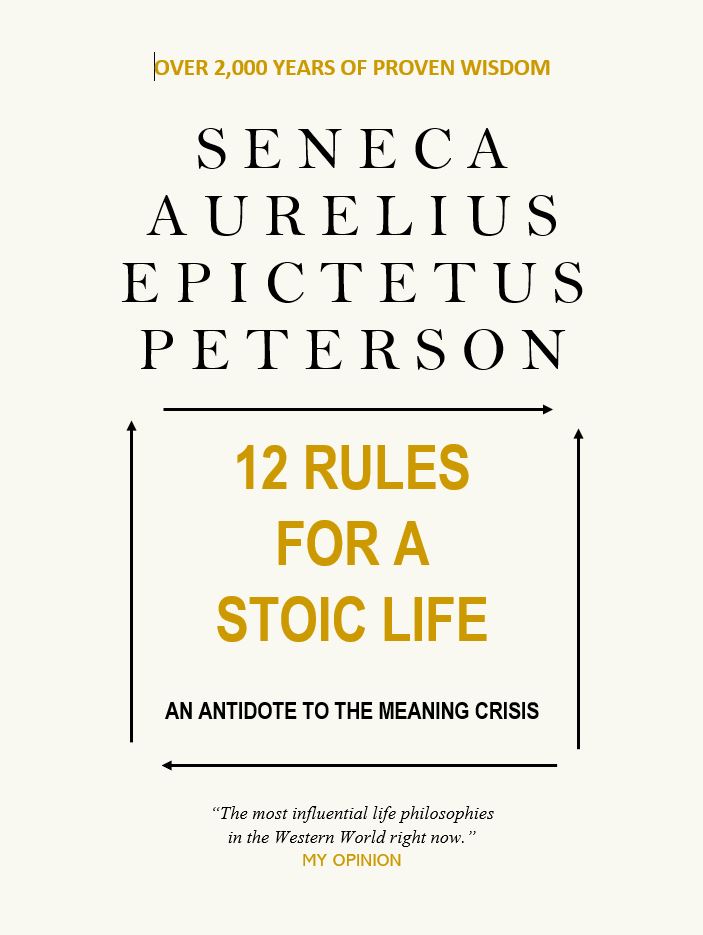
An Antidote to the Meaning Crisis
Maybe it is not that life has become that much harder, but people have become softer.
After ejecting himself from his bullet-ridden aircraft moments before crashing, Fighter Pilot James Stockdale hurdled towards the ground near the main street of a small village in North Vietnam. He whispered to himself: ‘Five years down there, at least. I’m leaving the world of technology and entering the world of Epictetus.’ The year was 1965. And he was right, in more ways than one. He was released in 1973. Like his Stoic guide, Stockdale too suffered physically and mentally. He was beaten by a group of villagers moments after landing suffering from a broken leg and vertebrae. Epictetus, a slave, has a lame leg due to mistreatment by an owner. Stockdale was kept in solitary confinement, living in total darkness for four years; he was chained in heavy, abrasive, leg irons for two years; he was malnourished due to a starvation diet; and he was denied medical care. These were unimaginable circumstances. In many ways, he owes his survival to Stoicism. When author Jim Collins asked him why some made it through, and others didn’t, he replied:
Oh, that’s easy, the optimists. Oh, they were the ones who said, ‘We’re going to be out by Christmas.’ And Christmas would come, and Christmas would go. Then they’d say, ‘We’re going to be out by Easter.’ And Easter would come, and Easter would go. And then Thanksgiving, and then it would be Christmas again. And they died of a broken heart. This is a very important lesson. You must never confuse faith that you will prevail in the end—which you can never afford to lose—with the discipline to confront the most brutal facts of your current reality, whatever they might be.
Truth and courage allowed him to endure torture and abuse and live to see his wife and children again.
I’m retelling a story here that all followers of Stoicism know well. The point is not to underscore the importance of the Stoic virtues, rather, it’s to ask a question: Why are we interested in Epictetus and company when we are firmly planted in the world of technology?
Scholars like to tell us that interest in Stoicism waxes and wanes, according to how tough the times are. Stoicism originally emerged and thrived during a historically difficult period: in the early phase – when Zeno of Citium forged the school – the Greek city-state was breaking down as the Roman Empire exerted political control over Greece. In later phases – around the time Marcus Aurelius wrote the Meditations – the Roman Empire was beset with a plague. Theory has it that the emphasis it places on focusing on what is in our control helps people live well during stressful times.
None of us have been somebody’s property. It is unlikely that any of us have been or will be permanently maimed. Marcus Aurelius lost six children during the plague; a statistic few of us are unlikely to match. And none of us can even imagine facing the torture and wretched living conditions that Stockdale lived through. At best, we can relate to Zeno, as we see the dominance of the West slowly erode in the face of a new world order. Yet, on the scale of an individual life, we enjoy more comfort and luxury than Marcus Aurelius could imagine. The supposition that difficult times have given rise to the surge in popularity is possible, yet not entirely convincing.
When we observe that it’s not only Stoicism that is gaining ground, but speakers such as Jordan
Peterson and other preachers of toughness, discipline, and perseverance; people like Jocko Willink, David Goggins, and Admiral McRaven, it would suggest that a groundswell of larger proportions is in full swing. Perennially popular psychology books like Grit is about perseverance, Mindset is about reframing failures as opportunities, even Michelle Obama’s latest title is about overcoming difficulties. This lends credibility to the hypothesis that life is delivering more setbacks than average at the moment. The directionality might go the other way too, the message might be finding a growing audience as life gets harder, or, the audience may be growing, irrespective of life is getting harder or not. In short, maybe it is not that life has become that much harder, but people have become softer.
Ironically, we have become softer as we attempted to become stronger. The last three decades of the twentieth century was marked by the self-esteem movement. Building esteem was seen as a potent vaccine against the inevitable challenges of life – that is exactly the type of language that was employed. And there are significant benefits to high esteem as there is a strong correlation with increased health and happiness. And the logic is sound, a vaccine effectively bolsters one’s capacity to respond to future threats. However, exposure is at the core of inoculation, our bodies are presented a weakened or denatured pathogen. The stressor is novel, yet within the body’s capacity to defend itself, and the immune system ‘learns’ how to cope with a ‘live’ threat later on. In striving to develop esteem we neglected exactly how a vaccine works. Helicopter parenting, safe spaces, and approaches to education and competition that ensure that everyone wins and eliminate the possibility of failure, ensured that whole generations rarely suffered from anything that would be debilitating for their esteem – it also ensured that nothing truly enabled it either.
By protecting people from failure, pain, and discomfort to ‘protect’ their esteem, we forgot how to ‘build’ it. In medicine, we use the terms immunocompetent and immune compromised. Therein lies the fundamental weakness of the self-esteem movement; confidence that is not built upon competence is vulnerable and easily compromised. “I judge you unfortunate because you have never lived through misfortune. You have passed through life without an opponent— no one can ever know what you are capable of, not even you.” Seneca asserts. In essence, it could be argued that we gained self-esteem at the expense of self-efficacy.
The consequences of the safety-at-all costs approach are playing out on the social and individual levels. By the 1990’s psychologists began to realize that the self-esteem movement that reached its pinnacle in the 70’s and 80’s had drawbacks. When one’s esteem is contingent upon external recognition and is low, people tend to chase anything that will temporarily boost it: possessions, sex, success, or physical appearance. The insecure person, incapable of appreciating themselves as someone with qualities and faults tends towards narcistic behaviours to protect their fragile ego (denial, projection, self-inflation, envy, arrogance, and aggression, to name but a few). In his seminal book, The Coddling of the American Mind, psychologist Jonathan Haidt has summarized the impacts on individuals and eloquently drawn a link to the social phenomenon playing out at the moment:
While people have fought for what they believe in over time, what’s new about the environment on college campuses today is the premise that students are fragile and need protection from all ideas, people, or interactions that may make them feel uncomfortable. But all of the protections being put in place – safe spaces, disinviting controversial speakers, trigger warnings, and so on – is that they actually increase the likelihood of students of students becoming fragile, anxious, and easily hurt. By not exposing people to the inevitable discomforts of life, including ideas that contradict your worldview, we’re making people less antifragile under the false premise of protecting them. By denying our youth the opportunity to have a free-range childhood, we restrict their chances of being free-range thinkers and the ability to tolerate the range of emotions that the vicissitudes of life will eventually deliver. It is thus not surprising that people are turning towards life philosophies that deliver what they lacked for so long.
Perhaps part of what we lacked was a more nuanced and realistic way of evaluating ourselves. Albert Ellis, co-developer of Rational Emotive Behavior Therapy (REBT), was highly critical of the self esteem movement. Although he saw benefits to improved confidence, the concept of qualifying one’s self-worth as a whole, as opposed to personal behaviors and characteristics, is dangerous. Who among us has not narrowly defined themselves as ‘useless’ or ‘worthless’ at a given moment for some error or shortcoming that is now long forgotten or utterly inconsequential? He proposed self-acceptance instead, an approach that encourages you to see yourself as valuable by default of being you, rife with qualities and foibles particular to you.
Given that Ellis was influenced by the Stoics, his acceptance-based approach to self-worth is not surprising. We all “possess a share of the divine” in Marcus Aurelius’ estimation. The Stoics also encouraged us to avoid looking for external validation, on this matter Epictetus sternly warns us : “If you are ever tempted to look for outside approval, realize that you have compromised your integrity. If you need a witness, be your own.” More importantly, to be a student of philosophy to the Stoics was to constantly be a work in progress. They propose that we take a moment each evening to review the day and identify areas for improvement. “From first to last review your acts and then reprove yourself for wretched [or cowardly] acts, but rejoice in those done well.” Epictetus advises. That we should evaluate ourselves fairly, acknowledging weaknesses without chastising ourselves for them, and simply do our best despite them is best displayed by the Stoic who, by his rank, could have commanded esteemboosting adulation. Instead, he was honest with himself: “No one could ever accuse you of being quickwitted. All right, but there are plenty of other things you can’t claim you ‘haven’t got in you.’ Practice the virtues you can show.”
Authenticity is a core element of self-acceptance; the individual must be dedicated to the truth, regardless of how hard it may be on the ego, in order to move forward from there. And move forward we must. The Stoics didn’t just disdain hardship, they saw it as a test of one’s meddle – a way to build character. The obstacle is the way says Ryan Holiday, neatly paraphrases Marcus Aurelius. It is through real challenges that real competence is developed. As Stockdale has noted:
“It sort of fell out of Epictetus’s proclamation that ‘difficulties are what show men’s character. Therefore, when a difficult crisis meets you, remember that you are the raw youth with whom God the trainer is wrestling.’ But our bottom line was this: The challenge of education is not to prepare people for success but to prepare them for failure. I think it’s in the hardship and failure that the heroes and the bums really get sorted out.”
By neglecting to prepare ourselves for failure, we may have also failed to prepare a route to
success. Smoothing out the ride, ensuring that our lives have no troughs and valleys may have negative consequences beyond fragilizing egos, it may also suck the marrow out of life. The flatness of a safe life, sheltered from the possibility of failure (and also any real success) compounds the interest in Stoicism and the message of Jordan Peterson and others with similar messages. Meaning is imparted upon our lives by confronting challenges and expanding our personal horizons, not shrinking from them in the name of safety and protecting our self-esteem. Seneca warned against being a tourist in life rather than embarking upon a true adventure two thousand years ago, “Often a very old man has no other proof of his long life than his age.” Peterson echoes this call to action and embarking upon a heroic path throughout his work. The emphasis he places on responsibility – an approach to life that involves doing difficult and important things – runs directly countercurrent to the fundamental ethic of security that underpinned the self-esteem movement:
“We have spent too much time, for example (much of the last fifty years), clamoring about rights, and we are no longer asking enough of the young people we are socializing. We have been telling them for decades to demand what they are owed by society. We have been implying that the important meanings of their lives will be given to them because of such demands, when we should have been doing the opposite: letting them know that the meaning that sustains life in all its tragedy and disappointment is to be found in shouldering a noble burden.”
Nassim Taleb’s pithy statement, “Modernity: we created youth without heroism, age
without wisdom, and life without grandeur.” outlines exactly why the message above resonates
so loudly. The consequences of the modern ethos has been characterized by Peterson’s
colleague John Vervaeke as a meaning crisis. In his estimation, “The Meaning Crisis is at the root
of modern crises of mental health… We are drowning in bullshit – literally ‘meaninglessness.’”
The etiology of this dis-ease is a lack of connection, “We feel disconnected from ourselves, each
other, the world, and a viable future.”
Peterson, like the Stoics, calls upon us to be the protagonists in our own lives. This approach, steeped in meaning, is a response to the modern antihero that existential literature warns against – an indecisive personality who drifts through a life of boredom, angst, and alienation. The antidote to the malaise of modernity (to borrow the term from Charles Taylor) is connection: responsibility,
authenticity, and agency. It is a philosophy of ‘being’ – of life as verb, as opposed to a noun – someone that is in constant evolution and on a continual quest, as opposed to ‘having’ a static identity and fixed traits. Thus, it is not the rules for living that Peterson and company and the Stoics provide that are drawing people in, but the spirit that animates the rules. Much like soccer is not the rulebook, what makes it the beautiful game is something in its essence. Overall, the popularity of each may be a reaction to an excess of attention on life by the rules; we have focused on ‘how’ to build esteem for example, or ‘what’ things we require to have a good quality of life (rights without responsibilities, material goods, security), and despite good intentions and many benefits, we many have left something behind along the way. Perhaps something else needed to come first.
The question we began with was why are they both so popular. ‘Why’ may also be the answer. Start with why Nietzsche advises us: “He who has a why to live for can bear almost any how.” At the core of their ‘how-to’ manual – how to live with confidence and connect meaningfully, for example – is a personal and enduring ‘why.’
In what ways do both schools offer similar advice? See 12 Stoic Rules for Life
K. Wilkins is the author of:
Stoic Virtues Journal: Your Guide to Becoming the Person You Aspire to Be
Rules for Living Journal: Life Advice Based On the Words and Wisdom of Jordan B. Peterson
 Find Your Journal