
Answering your child’s questions is among the great joys of parenting. Usually. Every question holds within it the opportunity to be dazzled by their curiosity, to encourage it, and to teach. As parents, we have the privilege to revel in their sense of wonder. When the question stupms us, as it often does, we can dismiss the question – we can shrug and say ‘because’ and thus teach them not to bother asking – or, we can get in touch with our inner child and experience wonder with them. If we don’t know why the sky is blue, we can tell them how good a question it is, we can explore for the answer with them. Even when the answer leads to more or deeper questions we have the opportunity to nurture the inner scientist kids naturally are.
One approach teaches them to follow their curiosity – to get to the bottom of things. The other teaches them to be satisfied with ignorance and a superficial understanding of things. Where would we be if Einstein and Edison and Da Vinci and the great minds of this world were taught not to bother figuring it out for themselves?
But not all questions are lofty fly balls. When my eldest daughter was about nine, rumours about the Man in the Red Suit began circulating amongst her classmates. Her questions became tougher. I vividly recall tucking her in bed on Christmas Eve, just as I was about to get-up and leave the room after saying goodnight, she asked me ‘Tell me Papa, is Santa real – I mean really? Just tell me.’ A somewhat precocious child, she stated it with gravitas, I could swear I was speaking with an adult. She wanted a genuine answer. I panicked. I didn’t provide it. I struggled to find a response. One part of me wanted to be upfront and provide the authentic response she requested, another part of my mind was saying ‘not now, just hold on to the magic for one more Christmas’.
If there was an elegant way out of that dilemma, I’m sure I fumbled It. I simply punted the question until later, I told her that we would discuss it the next day. She didn’t bring it up again. Maybe because the presents distracted her, more than likely because she wasn’t sure she’d get the truth. The next year, in November, we confirmed what she already suspected.
Exactly why I would unconsciously want to perpetuate this myth when it counters the very core of part of my parenting philosophy – dedication to the truth – I don’t know. It could be that there is something about the formidable power of imagination that believing in Santa requires. Maybe believing the fantastic benefits us ways I don’t fully grasp. Perhaps I want them to have faith that good things will come from unexpected places if you be the best person you can be? Perhaps my reluctance to answer had more to do with me than them? It may have been a lament or a denial of sorts, a refusal to recognize how quickly time was passing – a reluctance to accept that this magical phase of life was slipping away from me.
I was spared any psychological turmoil with my younger daughter. Last year, at nine-years-old, she pronounced the truth to us. She figured it out on her own and was proud of it. The rumours in the schoolyard, together with the obvious attempts by her sister and her older friends to promote the story gave it away. Even a child her age can sense when ‘thou dost protest too much.’ The truth is so much simpler (even if it sometimes seems stark compared to the beautiful lie).
This year, I can relax, sip my eggnog, and be content with the fact that I can promote consistent values and attributes with my children all twelve months of the year. I’ve come to terms with the fact that this magical phase of our lives – having young and impressionable children – is escaping us. The hard questions are behind us. Or so I thought.
At the outset of December I was listening to my 10-year-old daughter play piano. She was practicing for the Christmas recital. Her chosen piece was Il est né le divin enfant (The Divine Child Has Been Born), an 18th century French piece. Living in Quebec, so we are fortunate that we hear both the English and French traditional songs. Divine enfant is not part of the standard commercial playlist you hear in the mall. If you’re curious, the Vienna Boy’s Choir renders a good classical version. However, a lot of Christmas jazz gets played in this house, and my kids like a funky version by Dr. John best (possibly for the groove, but more likely because his mangled French accent reminds them of Dad’s).
Right in the middle of her practice session my girl asked ‘Papa, do you believe in Jesus?’ Admittedly, this question is more loaded than the one about a guy in red pyjamas and flying reindeer. Just when I thought I could relax and be truthful, we’re putting into question a dominant religion for a good part of the planet and part of the moral foundation of our Wester society – not to mention, the predominant religion here (every town and village name begins with Saint something) and the belief structure of members of our family. I was tempted, for a second, to do the same thing as I did with the Santa question. I could easily tell her that she will need to decide when she is older. If I did so, it would be a way of assuring that my beliefs don’t contaminate hers. I could simply say that I don’t know, and leave it at that. But that would be dishonest, I know exactly what I believe.
So I began where on should – with the truth, my interpretation. I told her that it is not something that anyone can know for sure. That many, many, people believe the story of Jesus. They believe that Jesus was the Son of God and that God sent him to Earth to speak to us. I told her that I do not believe that part of the story. I told her that he spread a message about how we should treat each other well. That part I believe with every fibre of my being.
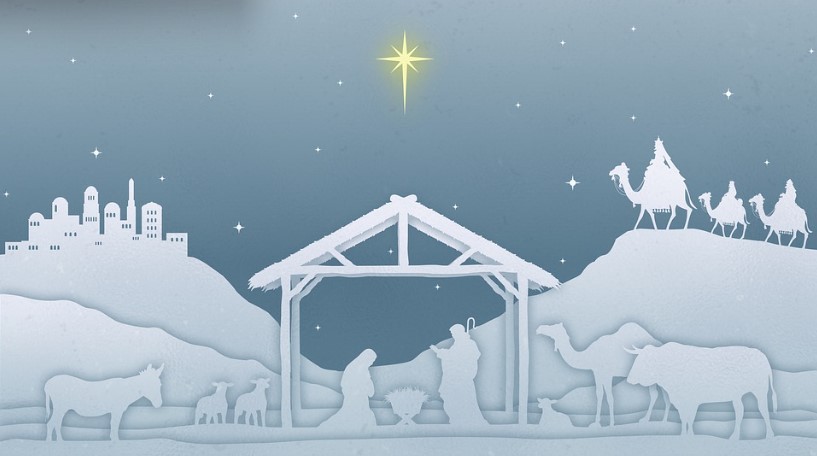
Seeing that her question was linked to the title of the song, I improvised a bit from there. I told her that I think that, when he said that he was the Son of God, maybe he was saying that we are all God’s children, that we are all divine. We put nativity scenes under the tree to remind us that the bond between children and parents is the most special part of living and the best thing that can happen to us. The most precious thing in the world is our children. And we are all lucky to have been born. I told her that the best day’s of my life, and her Mother’s, was when she and her sister were born. And every day after that has been wonderful. Each child is unique and special, there will never be anyone exactly like you. We celebrate the birth of Jesus at Christmas, but I think that we are really celebrating the joy of being a family together.
It was an improvised but honest answer to a spontaneous question. Maybe it could have been handled better, but I feel that I did better on the sacred Christmas question than the secular. Judging by the long and intense hug she gave me, her young mind somehow grasped the feeling underpinning the response. Perhaps there was a fundamental truth in the answer that her little heart needed to hear? Perhaps we all need to be reminded of it? Perhaps, irrespective of what my girls come to believe in terms of religion, they will come to perceive and believe what I do, that the truth is that reality is where the true magic resides.
W.Journaler (K. Wilkins)
Written December 2018
 Find Your Journal